
*
Admission Webhooks (Kubernetes) — Practical Notes
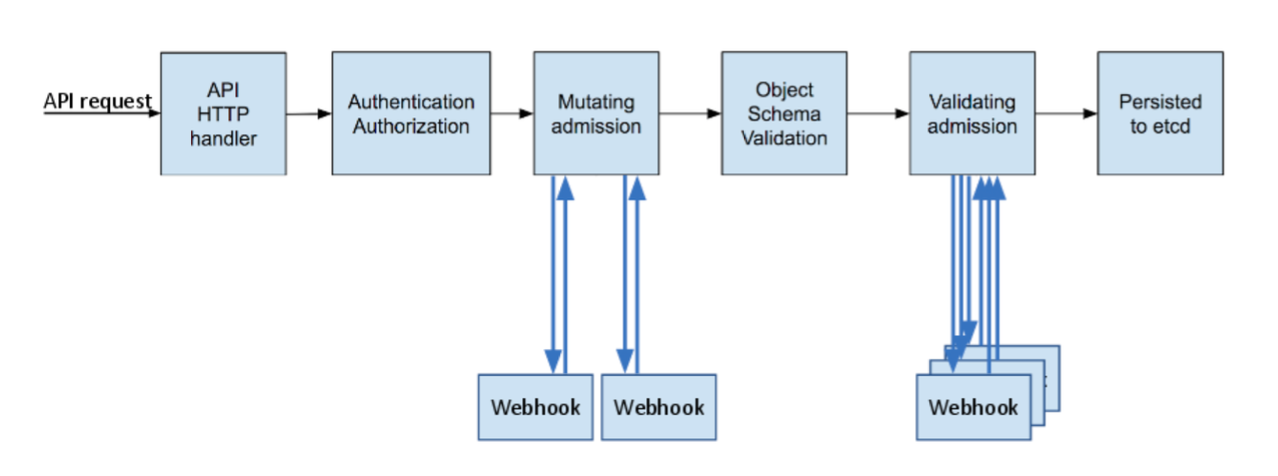
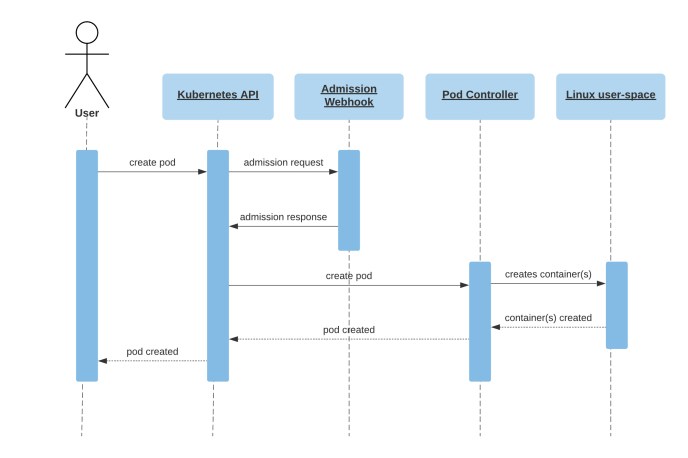
Admission webhooks sit between authentication/authorization and object persistence. They are API-server extensions, not runtime components, and they execute on every matching API request (create, update, delete, connect).
1. Where Admission Webhooks Execute (Critical Mental Model)
kubectl / client
   ↓
Authentication
   ↓
Authorization (RBAC)
   ↓
Admission Controllers
   ├─ MutatingAdmissionWebhook
   └─ ValidatingAdmissionWebhook
   ↓
etcd (object persisted)
Key implication If an admission webhook fails or times out (depending on failurePolicy), the API request may be rejected even if RBAC allows it.
2. Mutating vs Validating (Operational Difference)
MutatingAdmissionWebhook
Can modify the incoming object
Runs first
Typical use:
- Inject sidecars
- Add labels/annotations
- Set defaults not handled by API schema
ValidatingAdmissionWebhook
Cannot modify the object
Runs after mutation
Typical use:
- Enforce policies
- Block non-compliant resources
Golden rule Mutation makes objects convenient. Validation makes clusters safe.
3. What Actually Triggers a Webhook
A webhook triggers when ALL of these match:
- API group (e.g.,
apps,""for core) - API version (e.g.,
v1) - Resource (e.g.,
pods,deployments) - Operation (
CREATE,UPDATE,DELETE,CONNECT) - Namespace selector (optional)
- Object selector (optional)
This is why webhooks can be surgically precise or dangerously broad.
4. Real-World Use Cases (Practical, Not Theoretical)
4.1 Enforce “No :latest Image”
Type: Validating Why: Prevents non-reproducible deployments
- Trigger:
CREATE,UPDATEonpods - Logic: Reject if any container image ends with
:latest
Outcome: kubectl apply fails immediately with a validation error.
4.2 Auto-Inject Sidecar
Type: Mutating Why: Avoid developers manually adding boilerplate
- Trigger:
CREATEonpods - Condition: Namespace has label
mesh=enabled - Mutation: Append sidecar container spec
Outcome: Pod spec stored in etcd already includes the sidecar.
4.3 Enforce Required Labels
Type: Validating Why: Governance, cost allocation, ownership
Require labels like:
appownerenvironment
Outcome: Objects without labels never reach the cluster state.
4.4 Block Privileged Containers
Type: Validating Why: Security hardening
Reject if:
securityContext.privileged: truehostPathvolumes used
Outcome: Security enforced before workload starts.
5. Failure Modes You Must Understand
failurePolicy
FailAPI request fails if webhook is unreachable Use for security-critical controlsIgnoreAPI request continues if webhook fails Use for non-critical mutation
Production guidance Validating webhooks enforcing security should almost always be Fail.
timeoutSeconds
- Default: 10 seconds
- API server blocks waiting for response
Anti-pattern Slow webhook = cluster-wide deployment slowdown.
6. Operational Risks (Exam + Real World)
6.1 Self-Inflicted Cluster Outage
Webhook applies to:
podsdeployments
Webhook service is down
failurePolicy =
Fail
Result: No pods can be created, including webhook itself.
Mitigation
- Narrow selectors
- Use namespace exclusion
- Careful bootstrapping order
6.2 Infinite Mutation Loops
- Webhook mutates object
- Mutation changes something webhook re-triggers on
Mitigation
- Add idempotent markers (e.g., annotation
mutated=true) - Exit early if already processed
7. How Admission Webhooks Are Deployed (Practically)
Components
Webhook server
- Runs as a Pod
- Exposes HTTPS endpoint
Service
- Stable DNS for API server
TLS
- Mandatory (API server only talks HTTPS)
WebhookConfiguration
- MutatingWebhookConfiguration or ValidatingWebhookConfiguration
8. AdmissionReview Request / Response (Conceptual)
Webhook receives:
- Full object (
oldObjectfor updates) - User info
- Namespace
- Operation
Webhook returns:
allowed: true | false- Optional status message
- Optional JSON patch (mutation only)
This is synchronous and blocking.
9. Admission Webhooks vs Other Controls (Exam-Relevant)
| Mechanism | When it Acts | Can Modify | Can Block |
|---|---|---|---|
| RBAC | Before admission | No | Yes |
| Admission Webhook | Before persistence | Mutating: Yes | Yes |
| Pod Security Admission | Admission | No | Yes |
| OPA / Gatekeeper | Admission (via webhook) | No | Yes |
| Runtime security | After pod runs | N/A | No |
10. Key Takeaways to Remember
- Admission webhooks operate before objects exist
- They are synchronous and blocking
- Mutating runs before validating
- A broken webhook can break the cluster
- Always scope selectors tightly
- Prefer validation for safety, mutation for convenience
11. One-Line Exam Summary
Admission webhooks intercept API requests after RBAC but before persistence, allowing mutation or rejection of Kubernetes objects based on custom logic.
If you want, the next extension can cover:
- Step-by-step webhook deployment
- Common CKA traps
- Admission vs Pod Security Admission
- Debugging webhook failures in production
12. Minimal, Practical Code Examples (Incremental Add-on)
The sections below extend the existing notes by adding working YAML and logic fragments that correspond directly to the use cases already described. Nothing earlier is replaced.
12.1 Validating Webhook — Block :latest Images
Webhook Configuration (Validating)
apiVersion: admissionregistration.k8s.io/v1
kind: ValidatingWebhookConfiguration
metadata:
  name: deny-latest-tag
webhooks:
  - name: deny-latest.images.example.com
    admissionReviewVersions: ["v1"]
    sideEffects: None
    failurePolicy: Fail
    timeoutSeconds: 5
    rules:
      - apiGroups: [""]
        apiVersions: ["v1"]
        operations: ["CREATE", "UPDATE"]
        resources: ["pods"]
    clientConfig:
      service:
        name: image-policy-webhook
        namespace: admission
        path: /validate-images
      caBundle: <BASE64_CA_CERT>
Admission Logic (Pseudo-code)
for each container in pod.spec.containers:
  if image ends with ":latest":
    deny("image tag ':latest' is not allowed")
allow()
Practical effectkubectl apply fails immediately if any container uses :latest.
12.2 Mutating Webhook — Sidecar Injection
Webhook Configuration (Mutating)
apiVersion: admissionregistration.k8s.io/v1
kind: MutatingWebhookConfiguration
metadata:
  name: inject-sidecar
webhooks:
  - name: sidecar.inject.example.com
    admissionReviewVersions: ["v1"]
    sideEffects: None
    failurePolicy: Ignore
    rules:
      - apiGroups: [""]
        apiVersions: ["v1"]
        operations: ["CREATE"]
        resources: ["pods"]
    namespaceSelector:
      matchLabels:
        mesh: enabled
    clientConfig:
      service:
        name: sidecar-webhook
        namespace: admission
        path: /mutate-pod
      caBundle: <BASE64_CA_CERT>
JSON Patch Returned by Webhook
[
  {
    "op": "add",
    "path": "/spec/containers/-",
    "value": {
      "name": "mesh-proxy",
      "image": "envoyproxy/envoy:v1.30.0"
    }
  }
]
Practical effect Developers deploy normal pods; sidecars appear automatically in stored objects.
12.3 Validating Webhook — Required Labels
Webhook Rule
rules:
  - apiGroups: ["apps"]
    apiVersions: ["v1"]
    operations: ["CREATE", "UPDATE"]
    resources: ["deployments"]
Validation Logic
required = ["app", "owner", "environment"]

for key in required:
  if key not in metadata.labels:
    deny("missing required label: " + key)
allow()
Practical effect Governance enforced before workloads exist.
12.4 Validating Webhook — Block Privileged Pods
Validation Logic
for container in pod.spec.containers:
  if container.securityContext.privileged == true:
    deny("privileged containers are not allowed")

for volume in pod.spec.volumes:
  if volume.hostPath exists:
    deny("hostPath volumes are not allowed")
allow()
Practical effect Security policy enforced independently of RBAC.
12.5 Webhook Server (Skeleton)
HTTPS Server (Conceptual)
POST /validate
  decode AdmissionReview
  inspect request.object
  build AdmissionReview response:
    allowed: true | false
    status.message (if denied)
  return response
Key requirement
- HTTPS only
- Valid certificate trusted by API server
12.6 Bootstrap-Safe Selector Example (Outage Prevention)
namespaceSelector:
  matchExpressions:
    - key: kubernetes.io/metadata.name
      operator: NotIn
      values:
        - kube-system
        - admission
Why this matters Prevents the webhook from blocking its own Pods or system components.
12.7 Debugging a Failing Webhook (Operational)
kubectl get validatingwebhookconfigurations
kubectl describe validatingwebhookconfiguration deny-latest-tag

kubectl logs -n admission deploy/image-policy-webhook
Typical symptoms:
context deadline exceededno endpoints available for service- TLS trust errors
12.8 Exam-Focused Code Recognition Checklist
MutatingWebhookConfiguration→ JSON Patch presentValidatingWebhookConfiguration→ allow/deny onlyfailurePolicy: Fail→ cluster safety risk if misusednamespaceSelector→ blast-radius control- HTTPS + CA bundle mandatory
12.9 One-Line Extension Summary
Admission webhooks are implemented as HTTPS services registered via webhook configurations that synchronously mutate or reject Kubernetes API objects before persistence, with selectors and failure policies determining their operational safety.